Why Netflix’s No.1 Film≪The Great Flood≫Is Dividing Audiences — An Emotional Sci-Fi That Defies “Disaster Movie” Expectations
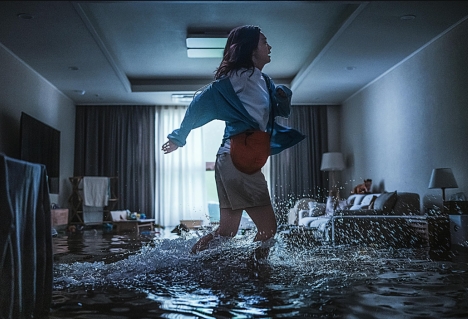
The Korean film ≪The Great Flood≫ (original title: 대홍수) premiered on Netflix on Friday, December 19, 2025. It quickly climbed to No.1 in Netflix’s global film rankings, drawing major attention across South Korea, Japan, and many other countries. Yet despite its popularity, the film has sparked sharply divided reactions. Many viewers say, “It wasn’t what I expected,” or “This wasn’t really a disaster movie,” revealing a striking gap between expectation and reality.
※The following contains plot details. Readers who have not yet watched the film should proceed with caution.
That very gap is the key to understanding ≪The Great Flood≫. From its title, visuals, and tagline—“the last day of Earth swallowed by a great flood”—most audiences likely anticipated a classic disaster spectacle. Instead, the film focuses less on the terror of rising waters and more on human emotion, presenting itself as a quietly contemplative science-fiction drama.
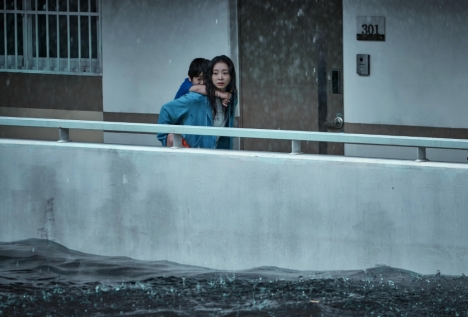
The story centers on Anna (Kim Da-mi), the head researcher of an AI laboratory who escapes as Earth faces imminent destruction. She carries a critical mission: to complete a “new humanity,” an artificial intelligence capable of possessing the same emotions as humans. At the same time, she searches for her missing son, Jain (Kwon Eun-seong), encountering various people inside a high-rise apartment building. Scenes such as rescuing a girl trapped in an elevator or helping with a birth in a hallway subtly echo Anna’s own memories as a mother, blending past and present through emotion rather than exposition.
 Images courtesy of Netflix
In the early stages, the film does deliver familiar disaster-movie tension. As melting glaciers and massive floods triggered by a meteor impact approach, survivors race toward the rooftop in a desperate struggle for survival. Visually, the film impresses: colossal waves engulfing an apartment complex provide powerful, immersive imagery. The climb to higher floors creates genuine suspense and a sense of immediacy reminiscent of classic disaster cinema.
 Images courtesy of Netflix
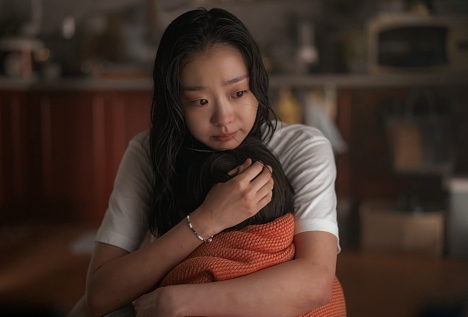
As the story unfolds, however, its true focus emerges. The central question shifts to: *What is the final element an AI needs to become truly human?* The answer the film proposes is not logic or data, but emotion—specifically, a mother’s heart.
 Images courtesy of Netflix
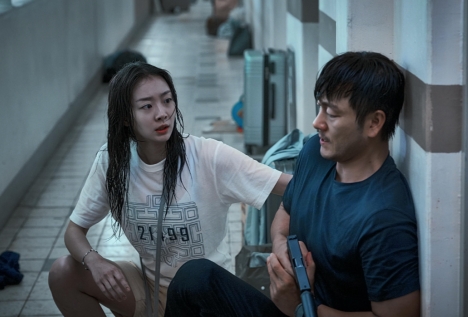
In the latter half, Anna is shown repeating tens of thousands of simulations in an effort to reach her son. The numbers printed on her T-shirts represent the number of attempts she has made, and each failure adds another layer of experience—much like an AI undergoing continuous deep learning. Jain’s haunting question, “Why am I always six years old?” and the sense of déjà vu felt by Hijo (Park Hae-soo) from the security team further reinforce the film’s emotional and conceptual framework.
 Images courtesy of Netflix
≪The Great Flood≫ is not a science-fiction film driven by complex theories or meticulously detailed scientific logic. Its structure is relatively simple, prioritizing emotional resonance over intellectual rigor. As a result, viewers expecting a straightforward disaster blockbuster may feel disoriented, while those who approach it as an emotional sci-fi drama often find it quietly moving and lingering in the mind.
 Images courtesy of Netflix
Despite topping Netflix’s global charts, reactions of “this wasn’t what I imagined” are understandable. Yet the film’s message—that emotion is what ultimately shapes the future—is universal. The “great flood” of the title may not refer solely to the water engulfing the city, but also to the overwhelming emotions that fill Anna’s heart. If viewers can accept the mismatch between expectation and reality, ≪The Great Flood≫ reveals itself as a film best appreciated for its subtle aftertaste rather than its spectacle.
This article is an English translation and adaptation of a Japanese article originally published on Navicon (https://navicon.jp/news/94929/).
【グローバル視点で読む韓国ドラ】


.jpg)
.jpg)


.jpg)


.jpg)


